Test record: Qwen3.8 Flash Next served successfully in an experimental AMD vLLM build on my 128 GB EVO-X3. Its 95.4 GiB BF16 embedding table stayed on NVMe; requested rows were copied exactly. At 32K input, repeated single-request first output fell from 306.42 seconds under llama.cpp/Vulkan to 81.04 seconds. Both deployments passed 27/27 retrieval checks. vLLM kept at least 44.35 GiB available during requests, with no measured swap-out in that phase. I restored the existing Lemonade GPU and NPU services afterwards.
My earlier Qwen3.8 ROCm and Vulkan work left a useful question open. Vulkan could run the model, but could vLLM make long prompts less painful on the same machine?
“Faster than Lemonade” is too loose a description. Lemonade manages the service. The production inference engine underneath it is llama.cpp, using Vulkan and a 103.7 GiB GGUF. For this test I needed a working native vLLM checkpoint, a memory plan and a measured comparison against that deployment.
The first obstacle arrived before any tokens per second. The four-bit checkpoint did not fit in 128 GB.
Four-bit experts do not make a four-bit model
I used wtdcode’s native AWQ W4A16 checkpoint, pinned to revision 0939125b. Its routed experts are INT4, with symmetric groups of 128. Other weights, including the PLE n-gram embedding table, remain BF16.
Reading the safetensors headers gave the actual storage budget:
| Component | Stored size |
|---|---|
| Text backbone | 67.225 GiB |
| BF16 PLE table | 95.368 GiB |
| Vision tower | 0.836 GiB |
| MTP head | 4.856 GiB |
The backbone and PLE alone total about 162.6 GiB. Linux sees approximately 124 GiB on this 128 GB machine. There is no allocation flag that closes that gap while also leaving room for KV cache and runtime workspaces.
CPU offload does not solve this capacity problem on Strix Halo. The CPU and Radeon 8060S share physical memory. The 120 GiB GTT allowance and 1 GiB dedicated reservation are not another 121 GiB of RAM sitting beside it.
The PLE table is the interesting part: 320,001,536 rows, each containing 160 BF16 values. A lookup needs selected rows, not a resident copy of every row. That made it a candidate for a disk-backed implementation.
Keeping the table on NVMe
The experimental module reads the safetensors headers, validates all 128 shards and maps them read-only. For each lookup it copies the requested IDs to the CPU, deduplicates them, gathers the rows and transfers the result to the GPU. It never creates the full embedding parameter.
There is no new quantisation of this table. The gather copies the original BF16 bit patterns. Synthetic CPU and GPU tests covered duplicate IDs, shard boundaries and empty inputs. Six sampled rows from the real checkpoint also matched the corresponding safetensors slices exactly.
After a gather, the module releases the mapped resident pages. Linux can still retain useful clean pages in its reclaimable file cache. “On disk” therefore does not mean every lookup must fetch every byte from the SSD again. That distinction matters when interpreting repeated-prompt results.
The price is synchronisation. This implementation moves IDs through the CPU and does filesystem work. It requires a single rank and eager execution; GPU graph capture is unsupported. I accepted those restrictions to establish whether the full text backbone could run within the memory budget.
Vision and MTP were disabled. The text backbone and routed expert count were retained: 48 layers, 512 experts and 10 selected experts per token.
Three compatibility problems before the first answer
I started from the existing AMD Flash Next vLLM development
work, copying the tree at
d4d0f73ef171154eac6f1914dca47001d662cfbb into an isolated workspace.
This was an adaptation of a development build, with existing gfx1151 compiled
extensions, rather than a clean installation of a released wheel.
First, AMD-SMI returned no device handles even though Torch/HIP could see the GPU. A fallback to HIP device discovery and naming got past that mismatch.
Second, the full model stopped at a QSA constructor check for dense FlashAttention. The actual AMD sparse-attention forward path uses its own Triton kernel. Removing the redundant availability check let that path run; all ten existing AMD QSA tests passed.
Third, a representative-shape fixture exposed the inherited KV cache updater. Its implementation had only been imported when optional FlashAttention was installed. The AMD path now calls the existing native cache scatter operation directly. An exact test across cache block boundaries passed before I tried the full model again.
These were specific compatibility fixes. I did not replace the sparse attention calculation with a dense approximation.
The successful smoke run loaded in about 70 seconds, with vLLM reporting 68.03 GiB for model loading. Multiplication, exact label retrieval and an ordinary explanation all worked. That was enough to begin a benchmark, not enough to declare the model qualified for every task.
What I compared
The host was a GMKtec EVO-X3 with Ryzen AI Max+ 395, Radeon 8060S and 128 GB of shared memory, running Ubuntu 24.04.4 and kernel 6.17.0-40-generic. The vLLM environment used ROCm 7.14, Torch 2.11.0 and Triton 3.7.1 development builds, with Transformers 5.14.1.
The two serving profiles deliberately expose the deployment difference:
| Setting | Experimental vLLM | Existing llama.cpp/Vulkan route |
|---|---|---|
| Checkpoint | Native AWQ W4A16 | UD-Q4_K_XL GGUF |
| Text backbone placement | GPU | Existing 40 GPU layers |
| PLE | BF16 rows gathered from disk | CPU memory-mapped GGUF path |
| KV format | BF16 | Q8 |
| Context per sequence | 33,280 | 33,280 |
| Sequences / slots | 2 | 2 |
| Prefill batch | 256 | 512, micro-batch 128 |
| Prefix reuse / speculation | Disabled | Disabled |
vLLM had a 4 GiB KV budget. The Vulkan arm used the existing qualified v0.7.1 binary. I reduced its normal two 262,144-token slots to the comparison size and disabled its host prompt cache. The NPU helper was unloaded during both arms.
Each engine received identical input token IDs at 512, 8,192 and 32,768 tokens, with one or two simultaneous clients. Three tokenizer probes covering the benchmark prose and control tokens matched between the native tokenizer and GGUF backend.
The prompt placed a unique label near the beginning, followed by repeated records, then asked for the label and an explanation. Sampling was greedy, with a fixed seed and a 128-token output cap. Responses could finish early. All 27 requests per engine returned the expected label; neither completed matrix had an HTTP failure.
Each length/concurrency case had three waves. The tables below use waves one and two, retaining wave zero separately because it can include first-use compilation or colder pages. Startup checks warmed common paths, but there was no separate warmup for every shape. Two repeats give descriptive results, not a confidence interval.
The first-output difference is substantial
| Input tokens | vLLM first output | Vulkan first output | TTFT ratio | vLLM output tok/s | Vulkan output tok/s |
|---|---|---|---|---|---|
| 512 | 1.47 s | 4.54 s | 3.08× | 13.34 | 17.31 |
| 8,192 | 19.70 s | 68.96 s | 3.50× | 13.05 | 14.75 |
| 32,768 | 81.04 s | 306.42 s | 3.78× | 13.62 | 12.17 |
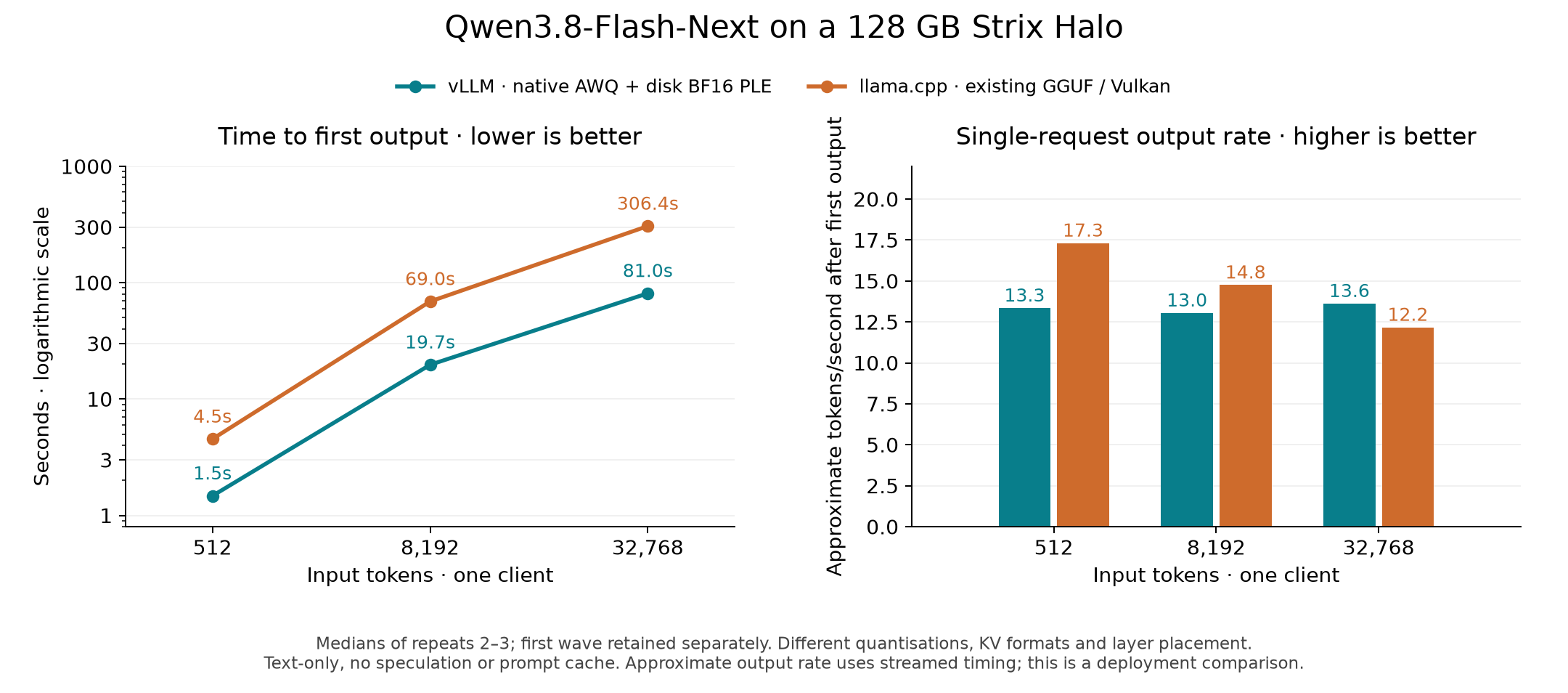
At 32K, waiting about 81 seconds instead of just over five minutes changes the usefulness of the service. The repeated median full-request time was 90.36 seconds for vLLM and 316.86 seconds for Vulkan.
Short prompts tell a less convenient story. vLLM begins sooner, but Vulkan generates faster once it starts: 17.31 against 13.34 tokens per second at 512 input tokens. The same ordering holds at 8K. I would not turn the first-output result into a blanket claim that vLLM decodes faster.
The output rates are approximate streamed measurements: generated tokens minus one, divided by time after the first non-empty output chunk. Chunking and end-of-sequence accounting can differ between backends.
Two clients still pay for prefill
| Input tokens | vLLM median first output | Vulkan median first output | vLLM aggregate tok/s | Vulkan aggregate tok/s |
|---|---|---|---|---|
| 512 | 2.22 s | 9.09 s | 19.01 | 13.65 |
| 8,192 | 29.90 s | 111.09 s | 4.58 | 1.29 |
| 32,768 | 122.87 s | 471.87 s | 1.39 | 0.40 |
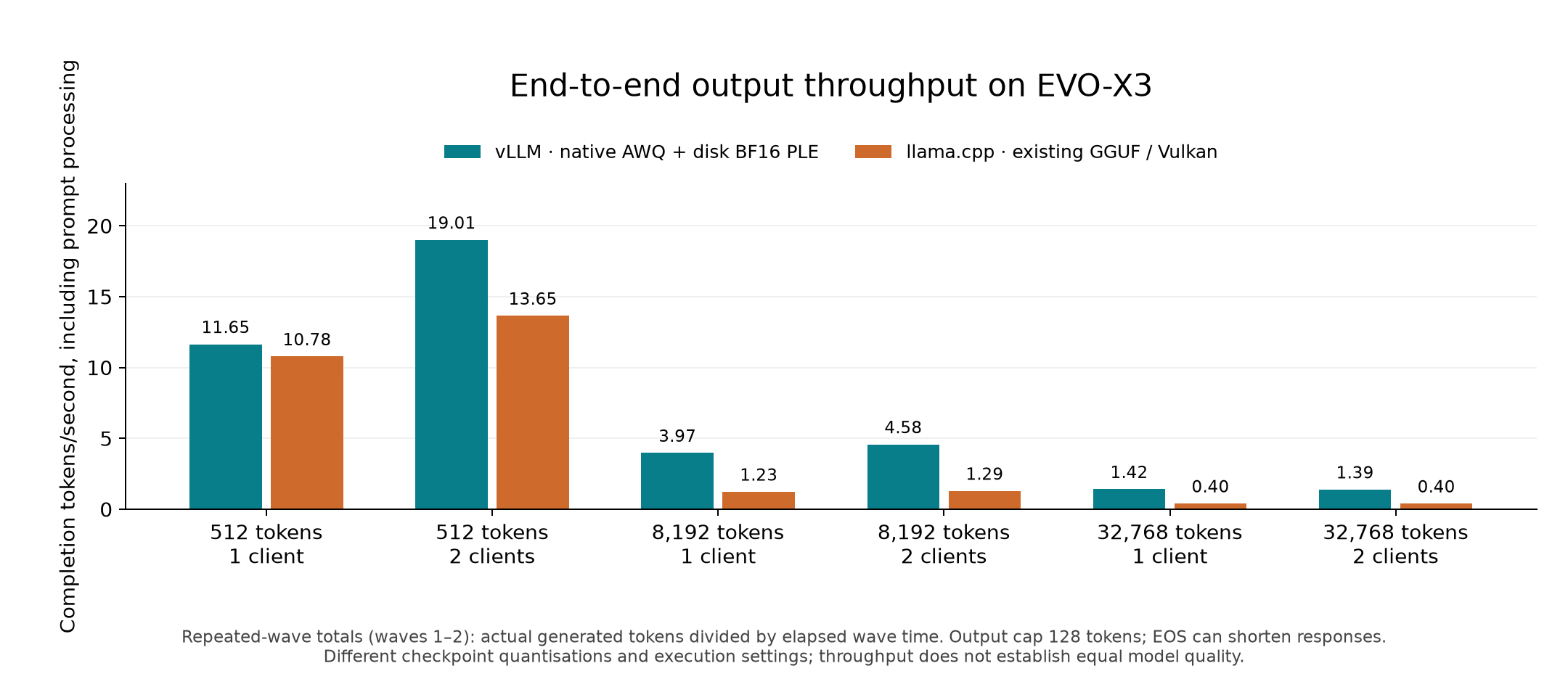
These first-output medians combine the earlier and later requests in each pair. Long prefills queue substantially on one GPU. Aggregate throughput counts actual generated tokens over the whole wave, including prompt processing; it is not the sum of two decode speeds. A request’s output interval can also contain pauses while the scheduler prefills its neighbour.
The unrounded measurement summary includes the first waves, completion counts and memory counters. The run manifest records the checkpoint, source revision, runtime and comparison settings.
The memory guard caught a startup I needed to inspect
| Deployment | Minimum available RAM during requests | Startup swap-out | Request-phase swap-out |
|---|---|---|---|
| vLLM | 44.35 GiB | 3.55 MiB | 0.00 MiB |
| llama.cpp/Vulkan | 56.82 GiB | 404.56 MiB | 1.48 MiB |
My first Vulkan baseline attempt stopped at a conservative 64 MiB startup swap-out guard, despite roughly 78 GiB still being available. I retained the failed run and allowed 512 MiB during the baseline’s retry startup. The 10 GiB available-memory floor and separate 64 MiB request-phase guard stayed in place.
That successful startup moved 404.56 MiB out to swap. The subsequent request matrix moved only 1.48 MiB. These are system-wide counters, including unrelated pages; they do not demonstrate that the model itself was being swapped. Available memory also includes reclaimable cache. Startup reclamation and sustained inference-time paging need separate treatment.
The available kernel journal for the trial window contained no matched GPU fault, reset or timeout events. The controller restored the original services, and the four recorded production configuration hashes were unchanged.
The production decision
I now have a working vLLM text deployment and a strong reason to investigate it for prompt-heavy work. I have not replaced the production service.
The existing Vulkan production profile serves much larger context slots than this experiment qualified. Its short prompt generation is also faster in this matrix. A 32K latency win is useful, but it does not establish equivalent context capacity or broad model quality.
The original Lemonade GPU model and pinned NPU helper were both ready again after the tests. Simultaneous vLLM and NPU inference remains untested here; the helper was unloaded for the comparison. Memory headroom alone is not a concurrency qualification.
The next useful work is a broader quality screen, more varied long prompts and a less synchronous PLE lookup path. Larger prefill batches also deserve measurement. None of those prospective improvements is included in today’s numbers.
Where I would stop claiming
This is a comparison of two deployments. Quantisation, KV format, layer placement, scheduling and kernels all differ. It cannot isolate an engine-only vLLM advantage, and it is not an exhaustive tuning contest.
Repeated filler exercises retrieval but gives a narrow view of PLE row locality. It does not establish worst-case cold NVMe behaviour on diverse text. Exact embedding lookup tests and 27/27 markers do not prove equal coding, reasoning or multilingual quality.
The result is text-only, single-rank, eager execution, without MTP. Inputs stop at 32,768 tokens. It depends on a patched development tree and reused compiled extensions, so it is not a claim of stock-wheel support or a fresh Linux build recipe.
What it does establish is concrete: the native text model can run within this machine’s memory by leaving the BF16 table on disk, and this particular vLLM deployment starts answering the measured long prompts much sooner.
Benchmarked 16 September 2026 on a GMKtec EVO-X3 with Ryzen AI Max+ 395, Radeon 8060S and 128 GB unified memory. Source changes, failed startups, streamed responses and recovery records were retained. Production was restored.